


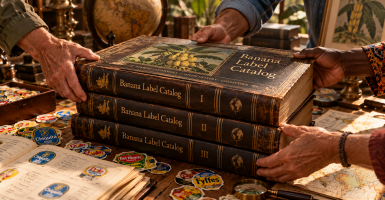
Every banana label collector knows the excitement of the hunt. We check the bananas in every supermarket, always hoping to discover something new. Even on holiday, we can spend hours exploring towns and villages, walking from market to market, searching for unfamiliar brands and labels. What others hardly notice can turn an ordinary shopping trip into a little adventure.
But the excitement doesn't end when we find a new label. Back home, we want to know more: Is it already known? Is the set complete? Where does it come from or have we discovered a new variant? This is where the Banana Label Catalog comes in.
The Banana Label Catalog is much more than a collection of pictures. It brings together thousands of banana labels, their variants, origins and stories, while helping collectors around the world explore, manage and exchange their collections. Above all, it is a shared project where collectors contribute their knowledge, discover new things and build something together that benefits our entire hobby.
1. A Shared Memory for Our Hobby
Banana labels are small, colorful objects that most people hardly notice. They are printed in huge numbers, attached to bananas, and usually thrown away without a second thought. Yet for collectors, they represent an amazing variety of brands, designs, countries and stories. But banana labels are also temporary. Designs change, brands disappear, and entire series may be used for only a short time. Once they are gone, information about their origin and history can easily be lost.
This is where the Banana Label Catalog plays an important role. It brings together information from collectors around the world and preserves it in one place, making it accessible to everyone. Unlike websites that mainly display pictures of individual labels, the catalog documents them in context. Where did a label come from? When was it used? Which set does it belong to? Are there similar versions from other countries or years? The catalog also preserves the stories behind the labels. Some sets were created by well-known artists or designers. Others were part of special advertising campaigns. One interesting example is Miss Chiquita, whose usual hand position was changed for a breast cancer awareness campaign.
Such details show that banana labels are much more than beautifully designed little works of art, often featuring flowers or exotic animals. They are also tiny witnesses to history, telling stories about the people, companies, places and traditions behind the bananas, and offering fascinating glimpses into the commercial, cultural and sometimes social history of their time.
2. Bringing Order to an Enormous Variety
With around 6,500 brands, more than 12,000 catalog entries and over 52,000 banana labels, the Banana Label Catalog covers an enormous variety of labels. But its real strength is not simply the number of labels. It is the way all this information is organized.
The carefully structured index allows collectors to find brands, sets and variants quickly. Instead of browsing through thousands of unrelated pictures, they can explore the known labels of a particular brand in a logical order. Sets are documented as sets, rather than just collections of individual images. Different versions are separated and described, including differences in design, country of origin and year of use. This makes it possible to understand how labels are related and how they have changed over time.
But what if you have a label and do not know its brand? The catalog offers another powerful tool: its detailed search function. Labels can be found by shape, color, text fragments, country of origin and even the motifs printed on them. Common motifs are systematically classified and can be used as search criteria. This detailed system of keywords and categories is one of the catalog's most distinctive features. Even a completely unknown Asian label can often be identified by a few visible characteristics.
The structured index and the search function complement each other. One helps collectors explore which labels are already known for a particular brand. The other helps them identify labels they have never seen before.
3. A World Full of Discoveries
One of the challenges of collecting banana labels is that we depend on what appears in our local shops. Sometimes the same brands and designs remain on the bananas for months, and there is simply nothing new to find. Fortunately, the world of banana labels is much larger than our local supermarkets.
The catalog allows us to follow new discoveries from other countries. A new Chiquita set in France, an unusual label from Asia or a previously unknown variant printed in Costa Rica can be interesting even if we never find it ourselves. There is always something new to explore.
And the catalog offers much more than labels. Its articles and galleries provide a wealth of information about the hobby and the world behind it. There are photographs from collectors' meetings, pictures of packing stations where labels are applied to bananas, and stories about unusual discoveries. There is also room for humor, such as the Sad Labels gallery, showing labels that were damaged, discarded or simply ignored by people who had no idea that someone might want to collect them. These articles and galleries make the catalog more than a reference database. They give us a glimpse into the people, places and processes behind our collecting objects.
Even on days when we have nothing new to add to our own collections, the catalog gives us a reason to return, browse and discover something interesting.
4. Everything for Your Own Collection
Of course, collecting is not only about looking at labels. We want to organize our collections, find missing items and exchange duplicates with other collectors. The Banana Label Catalog brings all these activities together in one system. Collectors can record which labels they own, see which ones are missing and keep track of their collections. They can also save information about when and from whom they received a particular label. Duplicates can be offered directly through the catalog, making them visible to other collectors who are looking for exactly those labels. The important advantage is that everything refers to the same catalog entries.
When two collectors arrange an exchange, they do not need to send separate pictures, prepare additional lists or spend time explaining which version of a label they mean. They can simply select the exact catalog entry. This is particularly useful when several labels look almost identical but differ in size, color, country of origin or other small details. The detailed documentation of variants therefore has a very practical purpose: it helps collectors exchange the right labels and avoids misunderstandings.
The catalog is not just a place to identify labels. It is also a place to manage a personal collection and connect it directly with the collections and duplicates of other members. Documentation, collection management and exchanging labels all work together.
5. Building Something Together
Perhaps the most important aspect of the Banana Label Catalog is that it is a shared project. Collecting is often an individual activity. Each of us has our own collection, our own interests and our own goals. But the catalog gives us something that we can build together.
Every collector can contribute. Someone may discover a new label and add it to the catalog. Another collector may recognize a missing variant, provide information about its origin or correct an error. Others may comment on an entry, confirm a difference or share background information about a particular set. Sometimes a small observation by one collector leads to a discussion involving several others. Together, they may discover something that none of them would have noticed alone. Every contribution adds another small piece to our shared knowledge.
The catalog is available in English, German, Spanish and Russian, helping collectors from different countries use the same reference and participate in its development. And this cooperation is not only useful. It is also enjoyable. There is a special satisfaction in discovering something new, solving a question together or helping to complete a set. The result benefits not only the people involved but everyone who uses the catalog in the future.
Over the years, thousands of individual discoveries and contributions have become something much larger than any single collection. The Banana Label Catalog preserves the past of our hobby, helps us enjoy collecting today and creates a foundation for future collectors. We have achieved something we can all be proud of. We have not only found a worldwide community of people who share this rather unusual hobby. Together, we have created a place where we can meet, exchange ideas, share discoveries, discuss differences and preserve our knowledge for the future. Our own collections belong to each of us. But what we have built together belongs to all of us. And every new label, every comment and every correction makes it a little better.
That is something worth being proud of. And something worth continuing together.
Michael
P.S.: What makes the Banana Label Catalog special to you? What keeps you coming back? Share your thoughts in the comments!